
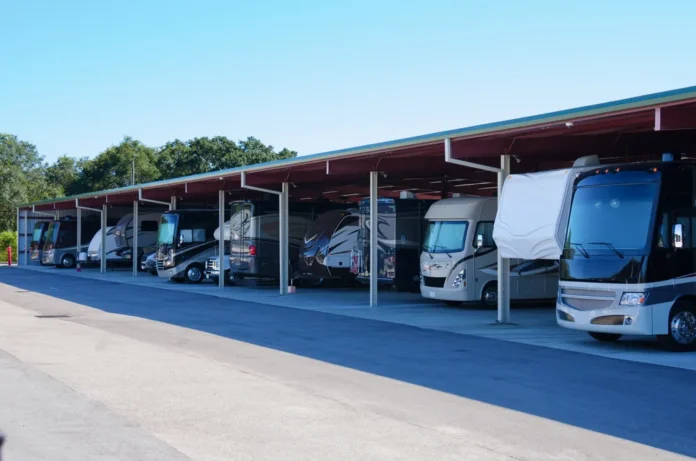
Investors applying traditional self-storage logic to RV facilities, prioritizing dense population centers, may be building in the wrong places. RV owners often want to store their vehicles not near home, but near where they vacation.
That pattern has significant implications for site selection, according to Phil Ingrassia, President of the National RV Dealers Association (RVDA). Ingrassia says the markets generating the most development interest are recreational destinations: Arizona, the Myrtle Beach area in South Carolina, Florida, and the Carolinas. These areas attract investment not because they are major metro areas, but because RV owners want short drives between a storage facility and a campground, lake, or coastline.
“Those are places where people want to store their RVs and then take them to the mountains or a lake or maybe the ocean,” Ingrassia says, “so that they drive their car to the storage facility and then just have a few miles – or under 100 miles – to go to a destination.”
The demand signal is strengthening. Ingrassia says investor interest in RV storage has grown noticeably since the pandemic, when a sharp spike in RV sales expanded the installed base. RVDA estimates roughly 8 million RVs are currently in use across the country. At the same time, homeowners’ associations and local zoning ordinances have steadily restricted where owners can park vehicles on their own property. This makes off-site storage a necessity, rather than a convenience, for a growing share of owners.
Why Site Selection Fails
In conventional self-storage, proximity to the customer’s residence drives occupancy. RV storage inverts that logic. A facility 30 miles outside a major city might score poorly on traditional storage metrics but perform well if it sits along a highway corridor leading to a lake or mountain range.
Ingrassia says the Southwest and Southeast coastal regions are seeing the most active development interest. Northern states present a different demand profile: owners there want to protect vehicles from winter weather. Even so, the destination-proximity logic still applies in many cases.
For investors, the practical implication is that market analysis for RV storage needs to incorporate travel behavior and recreational geography, not just census data. The top-selling states for RVs, Texas, California, New York, and Pennsylvania, reflect population size, but storage demand concentrates wherever those owners actually go on vacation.
Highway Access and Layout
Beyond recreational proximity, Ingrassia points to two operational factors investors frequently underestimate: highway access and the physical demands of storing large vehicles.
“It doesn’t have to be right within the recreation area, but it needs to be somewhat close and very accessible,” he says. “Places that have easy highway access, freeway access would be ideal.” For owners maneuvering a 40-foot motorhome, tight urban streets and complex interchanges are a problem. These sites push customers toward competitors that offer simpler ingress and egress.
The physical layout challenge is equally significant. Ingrassia says operators sometimes make costly spacing mistakes. “These are large units, so you can’t just kind of cram them all together really tightly like some places try,” he says. “You need to be careful that people can get in and out without damaging their units or damaging someone else’s units.”
That constraint directly affects how much revenue a given acre can generate. Investors accustomed to maximizing unit density in traditional storage facilities need to recalibrate their assumptions about land requirements and site design for RV-scale vehicles.
Basic to Premium Amenities
Ingrassia describes a wide spectrum of facility types currently operating. At the basic end are gated lots with video surveillance and controlled access. At the upper end, facilities offer electrical hookups so owners can check systems before departing, dump stations for waste disposal, and concierge services. Staff at these facilities will fuel a motorhome, fill water tanks, and confirm all systems are operational before an owner arrives.
The amenity level depends on the market. Ingrassia says some owners want bare-bones storage at the lowest cost, while others will pay a premium for a facility that eliminates pre-trip preparation. Investors with higher capital tolerance and willingness to manage staff can charge accordingly. The simplest facilities, secured outdoor lots with camera systems, represent a lower barrier to entry.
Consulting Infrastructure Still Developing
Ingrassia acknowledges that most real estate investors entering this space lack familiarity with RV owner behavior. Cushman & Wakefield has produced market studies on RV storage demand, and additional research firms have followed. Ingrassia also points to Toy Storage Nation, a Southwest-based consultancy focused on RV and marine storage, which runs extended workshops for investors and will present at RVDA’s convention in Las Vegas this November.
The value of specialized guidance, in Ingrassia’s view, lies in helping investors avoid treating RV storage like conventional storage. Customers behave differently, and site requirements vary. The geography of demand follows a logic that only becomes visible once you understand how RV owners actually use their vehicles. Ingrassia says dealers themselves are set up to sell and service RVs, not store them. Most maintain referral lists of local facilities rather than operating storage directly. That gap between where vehicles are sold and where they need to be kept is precisely what creates the opportunity for outside capital.
About the Expert: Phil Ingrassia is President of the National RV Dealers Association (RVDA), representing RV dealers across the United States.
This article is intended for informational purposes only and does not constitute legal, financial, or investment advice. The views and opinions expressed herein reflect those of the individuals quoted and do not represent an endorsement of any company, product, or service mentioned. Readers should conduct their own due diligence and consult qualified professionals before making any investment decisions.

