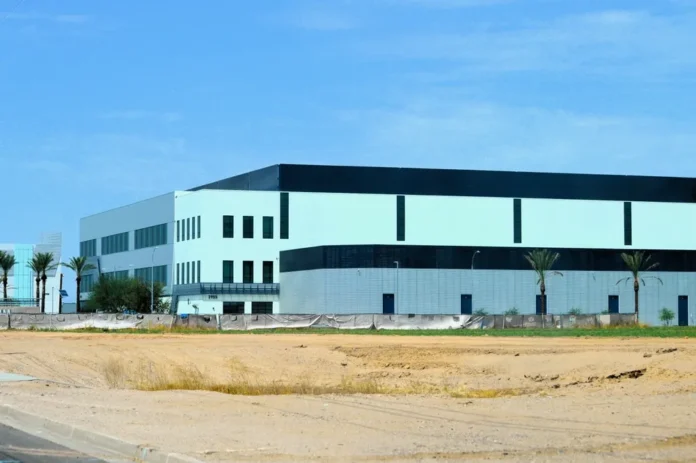
For years, Texas dominated conversations about where manufacturers and data center operators should expand. But New Mexico has been climbing site selectors’ shortlists, where a combination of pro-business policy, available power, water access, and aggressive state incentives is pulling deals away from more established industrial markets.
David Ebrahimzadeh, Founder & President of Corniche Capital, has been developing industrial real estate in New Mexico for over five years. He identified the state early as undervalued and has since watched it attract major institutional players – Meta expanding in Los Lunas, and the OpenAI-SoftBank-Oracle data center project in southern New Mexico among them.
“People are beginning to realize that it’s not just Texas that is open for business,” Ebrahimzadeh says. “New Mexico is in some cases outbidding and out-winning deals going head to head against Texas.”
What the State Is Offering
New Mexico’s pitch to manufacturers and technology companies spans financial incentives, physical infrastructure, and workforce development. The state’s economic development authority, along with local entities in areas like Los Lunas, has assembled a package that includes property tax abatements, employment incentives for hiring, and in certain cases, investment from what Ebrahimzadeh describes as “effectively the sovereign wealth fund of New Mexico.” Some companies have received non-dilutive cash from both state and local levels.
The physical infrastructure supports the incentive structure. According to Ebrahimzadeh, the state offers reasonably priced land, strong rail connectivity, substantial water resources with an efficient water rights system, and relatively inexpensive power. The permitting environment moves faster than many competing states. “You can get plans and permits approved fairly quickly, much quicker than other places in the country that I’ve been working in,” he says.
The workforce pipeline draws from research institutions including Los Alamos Labs and Sandia Labs, producing talent particularly suited to defense, aerospace, and quantum computing, sectors the state has specifically targeted for recruitment.
Beyond Powered Land
Ebrahimzadeh’s own strategy in the market has evolved. While earlier work in areas like Belen focused on selling powered land to hyperscalers, he is now exploring spec industrial and build-to-suit projects across the greater Albuquerque area. He remains open to building data center facilities for prospects with strong enough credit, but the broader opportunity he sees lies in serving the companies clustered around major anchor tenants.
That cluster includes startups, decently capitalized but not yet bankable in the traditional sense. Ebrahimzadeh says he conducts deep-dive underwriting on these ventures, sometimes agreeing to build for them or take them as tenants, and in other cases investing directly in their funding rounds. “I think that’s something that separates me from a lot of other industrial developers,” he says.
This dual role – landlord and investor – gives Ebrahimzadeh a different relationship with early-stage tenants than a conventional developer would have. Rather than requiring established credit from a traditional lender’s perspective, he evaluates the venture itself and decides whether the business merits both a lease and a capital commitment.
Choosing Markets
The focus on New Mexico is partly an affirmative bet on its advantages and partly a deliberate move away from less favorable environments. Ebrahimzadeh is completing several hundred thousand square feet of industrial space in New York but says he likely will not pursue further business in that state.
His preferred markets share a common profile: defined regulatory climate, efficient approvals, and business-friendly governance. Beyond New Mexico, he names Texas, South Carolina, Tennessee, and Alabama as top choices. For developers weighing where to deploy capital, the contrast matters: a faster permitting process and lower land costs reduce the timeline and upfront expense of getting a project to market, which in turn affects what rents a developer needs to charge and what kinds of tenants a building can attract.
Compounding Momentum
The state’s trajectory appears to be accelerating. After attending conferences focused on American reindustrialization and manufacturing, Ebrahimzadeh says New Mexico’s efforts “are beginning to ring true to a lot of people.” He reports that site selectors are increasingly including New Mexico on shortlists for companies expanding their manufacturing footprint, a development he attributes directly to the economic development authority’s engagement and the state’s willingness to compete aggressively on incentive packages.
Local officials in Los Lunas and surrounding areas have been proactive in bringing opportunities directly to Ebrahimzadeh as a developer and landlord in the region. That kind of active matchmaking between economic development offices and local developers is part of what distinguishes New Mexico’s approach; the state is not simply offering incentives and waiting for companies to arrive, but actively connecting prospective tenants with available sites and developers who can execute.
For companies evaluating where to locate manufacturing or data operations, New Mexico’s combination of cost structure, speed, and incentive depth now puts it in direct competition with states that have historically dominated those conversations. The question for the state is whether its current pace of infrastructure investment and talent development can keep up with the demand its own recruitment efforts are generating.
About the Expert: David Ebrahimzadeh is Founder and President of Corniche Capital, an industrial real estate developer with over five years of experience in the New Mexico market, focusing on powered land, spec industrial, and build-to-suit projects across the greater Albuquerque area.
This article is based on information provided by the expert source cited above. It is intended for general informational purposes only and does not constitute legal, financial, or real estate advice. Readers should conduct their own research and consult qualified professionals before making any real estate or financial decisions.