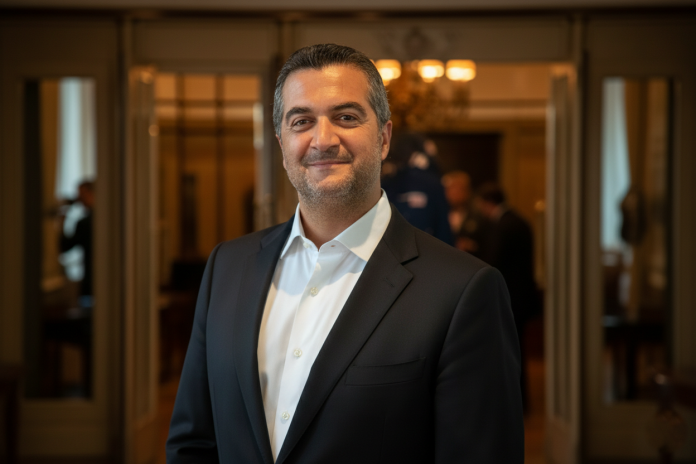
Industrial real estate has moved from the margins to the mainstream over the past two decades, becoming one of the most competitive sectors in commercial property. David Ebrahimzadeh, President and Founder of Corniche Capital, has closely tracked this change and adjusted his strategy to profit from the sector’s rapid rise.
Ebrahimzadeh grew up immersed in real estate in Cherry Hill, New Jersey. After graduating from The George Washington University in 2003, he started his career in real estate finance at Carlton Group in Manhattan, then quickly shifted into direct property acquisition.
“I grew up eating, breathing, sleeping, talking, living real estate,” he says. He credits his family with his early business education, and his first investments involved acquiring undervalued multifamily properties in New York and northern New Jersey.
He initially focused on B- and C-class multifamily buildings, amassing more than 1,000 units. But by 2006–2007, Ebrahimzadeh realized that managing these properties was labor-intensive and not aligned with his long-term goals. “It was too management-intensive for my liking, at least the class of multifamily that I was involved in,” he explains. “I realized I’d much rather exit that and redeploy into other types of real estate.”
Spotting Value in Industrial Real Estate
Around 2010, Ebrahimzadeh turned his attention to industrial properties, a sector then largely ignored by mainstream investors. This oversight created opportunities for those willing to look beyond traditional asset classes.
The pricing disparity struck him. “I could buy an industrial building with a tenant at 10 to 12 cap rates with credit, and be into the building for less than what the land alone was worth,” he explains. In many cases, the land value without improvements exceeded the total price he paid for the property and tenant.
This mismatch drew him into industrial real estate, which he describes as “the ugly duckling of real estate.” At the time, few investors were interested, allowing him to acquire properties at attractive prices. Starting in the Philadelphia area, he expanded nationwide, targeting both occupied and vacant buildings and value-add opportunities across multiple states.
Pandemic Shifts and Rising Competition
The onset of COVID-19 marked a turning point for industrial real estate. As e-commerce surged and supply chain concerns grew, the sector attracted mainstream attention and a wave of new capital.
“COVID is when industrial real estate really got the spotlight,” Ebrahimzadeh says. The increased attention brought higher prices and compressed cap rates, making it harder for individual investors to find value. “Now you have all these competing buyers driving up pricing,” he notes, adding that he operates without institutional partners and invests his own capital.
This new environment forced him to adapt. “It became very challenging to find any value-add opportunistic industrial deals to acquire that made sense,” he says. As a result, he shifted his focus to development, searching for land in secondary markets where pricing still allowed for profitable projects.
Choosing Markets for Growth
Ebrahimzadeh’s development strategy depends on markets with efficient permitting and supportive regulatory environments. He has moved away from traditional East Coast markets, which he finds slow and bureaucratic.
“In New York, New Jersey, Pennsylvania, it’s tough,” he says. “Even for an as-of-right property, you’re finding that it takes a year, two years, three years just to get to full entitlement on an as-of-right industrial property.”
Instead, he now prioritizes New Mexico, Texas, and South Carolina. New Mexico stands out for its pro-business approach and economic incentives. “New Mexico’s economic development authority at the state and local levels knows how to attract tenants,” he says. The state offers incentive, abatement, and grant packages to companies establishing manufacturing or distribution facilities.
The permitting process is also much faster. “In New Mexico, as long as you’re not looking for any variances, you can get permits inside of 30 days,” he says. “You could get site plan approval fairly quickly, and oftentimes permits inside of 30 days, which is probably one of the best turnaround times in the country.”
Manufacturing Demand Surges
Ebrahimzadeh’s current strategy aligns with the resurgence in U.S. manufacturing. Federal policies and supply chain concerns are driving increased demand for domestic production space.
“With the current priorities of this administration and the heavy push for re-industrialization, I’m beginning to see that the demand for manufacturing seems to be far surpassing the distribution demand,” he says. In his active markets, manufacturing tenants now drive most of the leasing activity.
This shift reflects broader economic changes, as companies seek to relocate or expand production within the United States. The result is heightened demand for industrial properties that support manufacturing operations, especially in regions with business-friendly policies and a labor force.
Unexpected Data Center Opportunities
While industrial development remains his focus, Ebrahimzadeh has also encountered opportunities in the data center sector—primarily by chance. Some of his properties are well-positioned for large-scale power access, a critical factor for data centers.
In Belen, New Mexico, he controls a site capable of securing several hundred megawatts of dedicated power, scalable to 600 megawatts. A similar opportunity exists with a 2,000-acre parcel in South Carolina.
Rather than pursuing data center development directly, Ebrahimzadeh prefers to sell power-ready land to operators seeking quick grid access. “I’d almost rather sell the powered land in those cases than to JV build or lease to the hyperscalers,” he says, citing uncertainty about long-term demand in the data center market.
His approach is to focus on sites with the shortest path to power, preferably in heavy-industrial areas where local opposition is minimal. This mirrors his broader investment philosophy: seeking value and minimizing friction in the development process.
Diversification and Innovation
Ebrahimzadeh’s investments extend beyond real estate. He has backed private equity ventures in building materials, logistics, and hedge funds, as well as venture capital. He has also developed intellectual property in automotive safety, filing three patents on seat belt systems and emergency evacuation—innovations that stemmed from his experience as a parent.
Looking Forward: Master-Planned Communities
As 2026 unfolds, Ebrahimzadeh is expanding his New Mexico operations to include large-scale mixed-use developments. He is planning master-planned communities of 1,000 acres or more in Los Lunas, a growing area near Albuquerque.
“There’s a massive need for additional housing,” he explains, and he aims to develop single-family homes, multifamily rentals, condos, and retail centers. This move builds on his industrial projects, creating integrated communities that serve workers attracted by new manufacturing and distribution jobs.
Advice for Investors: Flexibility and Timing
Ebrahimzadeh’s journey highlights the importance of recognizing overlooked sectors early, adapting to new market realities, and maintaining geographic flexibility. His willingness to pivot—from multifamily to industrial, from acquisitions to development, and from core markets to emerging regions—has allowed him to stay ahead of industry trends.
With American manufacturing on the rise and supply chain priorities shifting, industrial real estate remains a key area for growth. Investors who combine patient capital with strategic site selection and a clear understanding of regulatory dynamics are best positioned to capture long-term gains.
As the market continues to evolve, Ebrahimzadeh’s experience demonstrates that the ability to spot value, act decisively, and adapt strategies to new conditions remains essential for success in commercial real estate.