
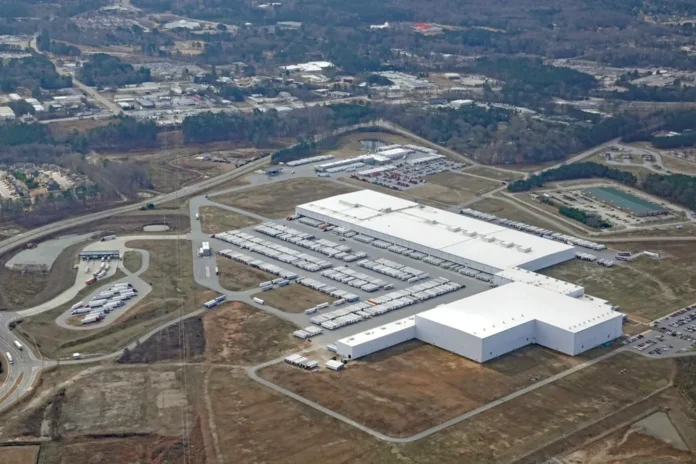
Rental rates for industrial space along Georgia’s 400 corridor have climbed from the $5 to $6 per square foot range to $13 to $15 per square foot – a shift that is squeezing out the small independent businesses that historically anchored the market. New construction is increasingly sized and priced for large corporate users, leaving startups and growing local companies with fewer viable options.
Scott Hanlon, Associate Broker at Powell Property Group, Inc., has watched this play out over years of working with small tenants along the 400 corridor. “Leasing rates used to be in the $5, $6 range,” Hanlon says. “Now they’re in the $13, $15 range a square foot – that’s kind of a shock to some of the tenants.” The gap between tenant expectations and market reality is not just a negotiating inconvenience – it is, according to Hanlon, actively preventing some businesses from finding space at all.
New Construction Skews Large
The core of the problem is a mismatch between what is being built and what smaller companies need. “A lot of the newer buildings that they built now are built for larger corporate companies that are 50,000 square feet up,” Hanlon says. Larger footprints attract creditworthy national tenants and command higher valuations, making them the rational choice for spec builders. But that development pattern is producing a supply gap at the lower end of the market.
Forsyth County has historically been an entrepreneurial market, according to Hanlon, where small companies start in a garage or home office, lease a few thousand square feet, and gradually scale up. He describes one tenant he worked with who started in a 4,000-square-foot space, grew into a 10,000-square-foot building, expanded that to 20,000 square feet, and eventually bought land and built a 40,000-square-foot facility. That kind of organic growth trajectory depends on affordable small-bay space being available at each stage. “The smaller guys are having a harder time finding small spaces to lease right now,” Hanlon says – and the new construction pipeline is not addressing that shortage.
For small businesses looking to establish or expand in Forsyth County, this means fewer options at each growth stage and longer searches for suitable space.
The Pricing Education Problem
When small tenants do find available space, the rate shock frequently stalls deals. Hanlon describes a recurring dynamic in which prospective tenants arrive expecting rates from a market that no longer exists. “If it’s $15 a foot and they think it should be $10 or $12 a square foot, you really can’t help them from that standpoint,” he says. The gap is not always bridgeable through negotiation – in many cases, the landlord’s pricing reflects genuine market demand, and the tenant simply cannot afford current rates.
Hanlon’s approach is to stay in contact with tenants who are not yet ready to accept market pricing, working to bring their understanding of current conditions in line with reality over time. But in a market where available small-bay space is already limited, tenants who cannot quickly adjust their expectations may find themselves without options. Some spaces, Hanlon acknowledges, are simply “tougher to lease out” – not because of property deficiencies, but because the pool of tenants who can afford current rates at smaller square footages is narrower than it once was.
If the entry-level industrial space that allows small companies to establish and grow is no longer accessible at viable prices, the pipeline of locally grown businesses that eventually become larger tenants and buyers may thin over time.
Navigating Both Sides of the Divide
Hanlon works across both sides of this market – representing landlords trying to maximize returns on properties that have appreciated significantly, and working with smaller tenants and buyers trying to navigate pricing that has moved well beyond their reference points. His firm’s long-standing relationships with building owners along the 400 corridor, some spanning more than two decades, give him standing to have frank conversations about pricing strategy and tenant selection.
“You have to provide them with a good knowledge base and protect them as much as you can,” Hanlon says of his work with landlords evaluating lease proposals. That includes helping owners weigh not just the highest rate, but the right tenant – a consideration that becomes more complex when the gap between what small tenants can pay and what the market demands continues to widen.
Meanwhile, the broader market shows no signs of slowing. According to Hanlon, at least a half dozen industrial developers are actively looking for land sites in Forsyth County, and between half a million and a million square feet of spec building is currently under construction, with additional projects proposed but not yet started. Land prices have not declined – they rose sharply two to three years ago and have held or continued climbing since.
For small tenants, that momentum cuts both ways. A growing market means more economic activity, but the new supply being built is not aimed at them. Until developers see a viable return in building smaller, the small tenant squeeze in Forsyth County is not easing.
About the Expert: Scott Hanlon is Associate Broker at Powell Property Group, Inc., with experience dating to the mid-1980s serving the Georgia 400 corridor from Roswell and Alpharetta north through Forsyth County, with a focus on industrial leasing, land sales, and investment properties.
This article is intended for informational purposes only and does not constitute legal, financial, or investment advice. The views and opinions expressed herein reflect those of the individuals quoted and do not represent an endorsement of any company, product, or service mentioned. Readers should conduct their own due diligence and consult qualified professionals before making any investment decisions.

