
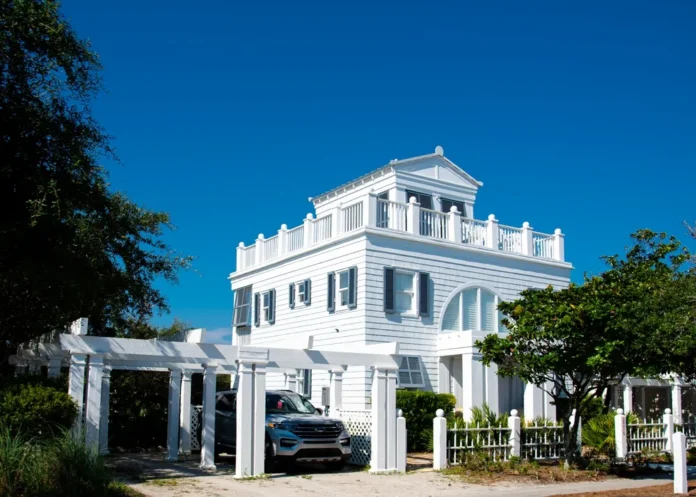
Along Florida’s 30A corridor, a growing divide between new construction and aging inventory is forcing sellers of older homes to confront a changed buyer pool. Buyers haven’t shifted their focus to price. They’ve shifted it to certainty.
According to Richard Jabbour, Founder & Broker Associate of The Jabbour Luxury Group with Scenic Sotheby’s International Realty, the 30A market has split into two categories: homes that buyers want to experience and own, and homes that will not attract serious interest. Jabbour says this divide is not primarily about affordability. It is about insurance underwriting, building standards, and the growing unwillingness of luxury buyers to absorb structural unknowns.
Insurance Underwriting Drives Demand
Buyer sensitivity to home age has become one of the most consequential filters in the current market, according to Jabbour. Buyers are gravitating toward homes built after 2010, when updated hurricane-resistant construction standards became more common in the region. Newer roofs, impact-rated windows, and modern structural designs translate directly into easier insurance underwriting and lower premiums. Buyers are now explicitly factoring this calculation into their decisions.
“People are more sensitive to the newness of the home,” Jabbour says. “They want to make sure it’s built under newer standards. Typically, people like to see homes built after 2010. That means the windows are in good shape and the roof is not too old, and they can do the inspections and get a good insurance rate.”
Older homes that fall outside those parameters aren’t simply selling at a discount. They’re struggling to attract buyers at all. Jabbour notes that homes requiring significant work face a narrowing pool of interested parties, regardless of location or historical appeal. New construction, by contrast, eliminates those concerns. “A new home has no question marks about it,” Jabbour says. “It’s built right, it’s built new. It has all the proper hurricane designs, and they get very, very good rates.”
For sellers of older homes, this means cosmetic improvements alone may not be enough. Buyers now weigh insurability and structural standards before they consider aesthetics or location.
Communities Diverge Across 30A
The split is playing out differently across 30A’s distinct communities. Watercolor, Jabbour says, has recovered. Pricing has stabilized and is trending flat to slightly upward after a period of softness, and correctly priced homes move quickly. Alys Beach, with its newer inventory, is achieving strong pricing. Seaside, the community Jabbour describes as the one that “started it all,” is having a slow transaction year overall. Still, the homes that are selling there are newer builds and high-quality renovations.
“Brand new homes in communities like Alys Beach, really updated homes in Watercolor, and brand new homes that have come out of the ground in Seaside are getting extraordinarily good pricing,” Jabbour says.
Rosemary Beach appears to be in a holding pattern. Jabbour attributes its slower pace not to distress but to seller patience. He says he is not seeing significant list price reductions there, which suggests sellers are willing to wait rather than reduce prices.
Implications for Luxury Markets
The dynamic Jabbour describes carries weight in any secondary luxury market where purchases are discretionary, and buyers have alternatives. When insurance costs and underwriting difficulty become meaningful factors in a buyer’s decision, properties that require capital investment to meet modern standards face a structurally smaller pool of buyers.
The buyers Jabbour describes aren’t rate-sensitive; they have the liquidity to purchase. What they’re increasingly unwilling to absorb is uncertainty about ongoing costs and insurability. For sellers and agents positioning older inventory, the implication is clear: pricing strategy alone cannot overcome a home’s failure to meet current building and insurance standards.
A New Construction Strategy
Jabbour and his team have responded to this environment by making new construction a core part of their business. Rather than focusing exclusively on resale transactions, the team works with investors who buy land, build homes, and bring those homes to market. Jabbour says this strategy is where the real returns are generated.
“The better investment and the way to make higher dollars and higher returns on your capital is to buy land, build a home, and resell that home back to the market,” Jabbour says. “That’s where the real money is made down here on 30A.”
Over the previous five years, the team brought 22 new homes to market with an average selling price of approximately $5.2 million, according to Jabbour. The pipeline includes approximately 21 additional new homes expected to come to market over the next couple of years, with several beachfront properties projected to sell for $21 million. For buyers in this segment, purpose-built new inventory offers a path around the insurance and condition concerns stalling older listings. That path exists, however, only at price levels where those construction economics work.
About the Expert: Richard Jabbour is Founder and Broker Associate of The Jabbour Luxury Group with Scenic Sotheby’s International Realty.
This article is intended for informational purposes only and does not constitute legal, financial, or investment advice. The views and opinions expressed herein reflect those of the individuals quoted and do not represent an endorsement of any company, product, or service mentioned. Readers should conduct their own due diligence and consult qualified professionals before making any investment decisions.

