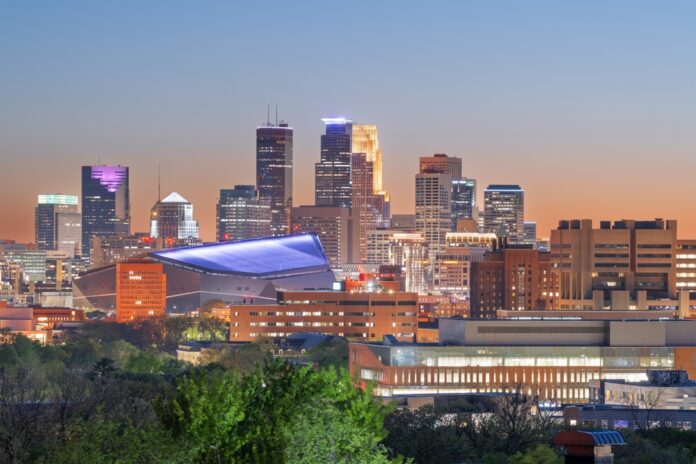
Downtown Minneapolis is home to major league sports, live theaters, concert venues, and a dense cluster of restaurants and bars, creating a robust entertainment district. Yet concerns about safety — especially among suburban residents who visit infrequently — are discouraging investment and reducing occupancy, according to Steve Brandt, President of the Minneapolis Board of Estimate and Taxation. Brandt says the gap between actual and perceived safety is fueling a feedback loop that weakens the city’s tax base.
“There are people who don’t come downtown very often who aren’t as well informed about how generally safe things are, and who sometimes will be reluctant to come downtown,” Brandt says.
This perception problem compounds pressure from remote work and declining office demand, making it harder for downtown commercial property values to stabilize. As those values drop, the property tax burden shifts increasingly to homeowners across the city.
What Downtown Minneapolis Offers
Several major venues anchor downtown Minneapolis: a Major League Baseball stadium, a Major League Basketball arena that also hosts concerts, and three city-backed theaters and performance spaces. The district supports an active restaurant and bar scene, designed to serve crowds drawn by sporting events and performances, and has the infrastructure to handle large gatherings.
Brandt, who regularly takes the bus home late at night after attending games, says his own experience downtown is uneventful and safe. He contrasts this with the views of people who visit less often and may rely on news reports or secondhand stories.
“I go downtown and take the bus home late at night for a ball game and never have problems,” he says. “But there are people who don’t get to the central city very often, who aren’t as well informed about how generally safe things are.”
This disconnect between the experiences of regular downtown users and the perceptions of occasional visitors is a major barrier to recovery. Potential tenants, investors, and customers who believe downtown is unsafe are likely to stay away — regardless of what crime data or daily experience shows.
How Perception Drives Behavior
Brandt acknowledges that perceptions, not just facts, drive behavior. Even if downtown is statistically safe for most people most of the time, the belief that it is not safe influences decisions about where to open a business, lease office space, or spend an evening.
Suburban residents who rarely visit downtown are especially likely to hold negative views. These individuals could be customers for downtown businesses, employees for downtown companies, or investors in downtown real estate. If they believe the area is unsafe, they won’t participate in its recovery.
Brandt believes that concerns about downtown safety are “over-emphasized,” but changing entrenched beliefs is difficult. Media coverage of isolated incidents reinforces negative impressions, and social media amplifies those stories, creating a cycle that is hard to break.
Skyway Insulates Visitors
Downtown Minneapolis features three large parking ramps connected to the Skyway system — a network of enclosed, elevated walkways linking buildings. This setup allows visitors to drive in from the freeway, park, access venues via the Skyway, and leave without ever setting foot on city streets.
Brandt sees this as a practical response for people worried about personal safety, but also as a lost chance for deeper engagement with the city.
“There are three huge parking ramps downtown that if you are concerned about personal safety, you can literally pull in from the freeway, find your parking spot, take a Skyway to the arena or the ball field and leave without ever encountering urban Minneapolis, which I think is a shame, but I guess some people are more comfortable that way,” Brandt says.
While the Skyway lets people enjoy downtown’s amenities, it also keeps them separated from the street-level experience. As a result, visitors who might update their views based on firsthand experience instead remain insulated, relying on media narratives rather than direct observation.
Perception Depresses Property Values
The consequences of negative perceptions are not limited to foot traffic — they affect the city’s finances. Businesses considering downtown locations weigh employee concerns about safety. Investors factor in the risk that demand will be weak. Landlords have trouble attracting tenants when companies believe their staff won’t want to work downtown.
Brandt points out that some corporations are bringing workers back to downtown offices, and government agencies have mostly required in-person work. This supports nearby restaurants and bars, but it does not fully offset the reluctance of other potential tenants and visitors.
“Some of our downtown-based corporations are bringing workers back. Governments have largely mandated a return to work, and that helps the government,” Brandt says. “It doesn’t really help the commercial market, but it does help some of the viability of ancillary things like restaurants for lunch and bars for after work.”
In an effort to make downtown appear more lively, the mayor has made vacant storefronts on the main pedestrian mall available to artists as studio and gallery space at low cost. The goal is to give the area a sense of activity, even if it doesn’t generate much revenue.
“That’s a psychological thing more than a real financial rebound,” Brandt says.
While this approach acknowledges the importance of perception, it is only a temporary fix. It does not address the root of the problem or generate the economic activity needed to stabilize property values.
Two Paths to Stabilization
Brandt identifies two possible paths to stabilization: either businesses move in to take advantage of low rents and fill vacancies, or commercial space is converted to residential use.
“What would need to happen is either for groups to say, hey, there’s lots of cheap space available downtown right now because rents have gone down. Come in, take advantage of it, fill up that space, or for some of that commercial space to be converted to residential use,” Brandt says.
A notable office-to-residential conversion has been completed, but Brandt has not received updates on its performance. He is skeptical about large-scale conversions, given the challenges of adapting office buildings for residential use, particularly lighting and layout.
The more immediate option — businesses moving in to capitalize on low rents — depends on overcoming the perception hurdle. If businesses believe their employees or customers will avoid downtown, they are unlikely to lease space, even at a discount. The perception problem blocks the market correction that would typically occur in response to lower prices.
Brandt is cautious about predicting when downtown will recover. He once estimated a five- to seven-year timeline for stabilization, but now considers that projection optimistic. He is waiting for clearer signs before revising his outlook.
“I’d like to be an optimist, but I gotta wait until there’s some clear signs before I go that,” he says.
Policy Has Limits
As President of the Board of Estimate and Taxation, Brandt’s focus is on property tax policy and city bonding. He has advocated for diversifying city revenue sources to ease the shifting tax burden on homeowners as commercial property values fall. However, even the best tax policy cannot solve the downtown problem if negative perceptions keep investors and tenants away.
The gap in perception between regular downtown users and suburban residents is not something the Board can fix on its own. Addressing it will require broader efforts — changing narratives, providing positive experiences, and demonstrating that downtown is a safe, viable place to work, visit, and invest.
Until perceptions improve, downtown commercial property values are likely to remain under pressure. As long as those values stay low, residential property owners across Minneapolis will continue to shoulder a growing share of the city’s tax burden — a direct financial consequence of a perception problem that has become a reality for the city’s budget.
What Will Shift Perceptions?
The future of downtown Minneapolis depends on more than policy or infrastructure. It hinges on whether people are willing to test their assumptions about safety firsthand. If regular activity and positive experiences can begin to outweigh negative narratives, the district could see a gradual return on investment and occupancy.
For now, the city faces a challenge that is as much psychological as it is economic. The path to recovery will require not just new tenants or new uses for old buildings, but a shift in how people view and use downtown itself. Until that happens, the perception gap will remain a barrier to both financial stability and civic vitality.