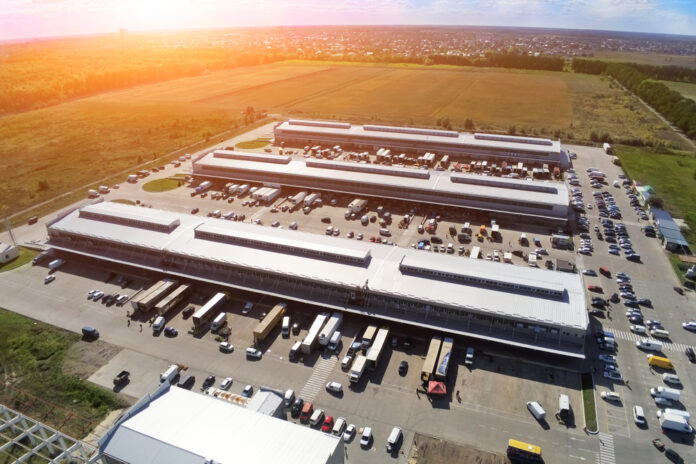
Industrial real estate in Southern New Hampshire is operating near full capacity, yet the pipeline of new space remains thin. David Choate, Executive Vice President at Colliers International, has spent more than three decades tracking the New Hampshire commercial market from the seacoast to the southern tier. He describes an industrial market where demand continues with little sign of slowing, while high construction costs and scarce developable land prevent that demand from being met.
The result is a market where appetite for industrial space is strong and consistent, yet the economics of building new product do not work for many developers.
Demand Outpaces Available Supply
Choate describes industrial demand as continuing “unabated,” while the supply side faces significant friction. Construction costs remain elevated, pushing asking rents beyond what prospective tenants will accept. Land is hard to find, and the math on new construction rarely works.
This constraint is most visible in the contractor-bay segment, which includes smaller flex industrial units ranging from roughly 2,000 to 20,000 square feet. These units appeal to electrical contractors, landscapers, storage users, and similar service businesses. Though the niche is seeing significant interest from both tenants and investors, it is not expanding quickly. “There’s a huge demand, but only to a certain price point,” Choate says.
Recent leasing activity illustrates the broader strength of the industrial sector. HCA Healthcare and Georgia Pacific occupied a single building of approximately 110,000 square feet in the seacoast area for storage operations. Biotech and medical technology companies have also been active tenants. Choate suggests these deals represent only a portion of what the market could absorb if more space were available.
By contrast, the office market tells a different story. Vacancy remains elevated across most submarkets, a trend that has persisted since the pandemic. Some developers have responded by converting underperforming commercial buildings into multifamily properties. That said, Choate notes an uptick in office leasing over the past year, which he attributes to companies requiring employees to return to the office at least three days a week.
Structural Barriers Limit New Construction
New Hampshire’s industrial market faces structural constraints that set it apart from high-growth distribution corridors in states such as Tennessee and Texas. The state sits at the end of the regional transportation network, faces some of the highest electricity costs in the country, and has limited municipal water and sewer infrastructure. These factors have historically discouraged large-scale industrial development.
“We don’t have these huge projects of several million square feet for an Amazon distribution facility,” Choate says. The mega-warehouse complexes visible along major interstate corridors in the mid-Atlantic and Southeast do not materialize in New Hampshire.
The state’s 13 cities account for most of the land served by municipal utilities, and not all of that land is available or appropriately zoned for industrial use. This limits where developers can build and constrains the total developable footprint, even in strong submarkets around Nashua and Manchester. For distribution-heavy users, high energy costs add another layer of friction that can tip location decisions toward other markets.
Investors Face Scarce Inventory
For investors, a tight vacancy creates a straightforward thesis: a quality asset with a creditworthy tenant on a long-term lease should trade at a reasonable price. The challenge is finding the product in the first place.
Cap rate expectations are running at roughly 7% to 8%, according to Choate, reflecting borrowing costs in the 6% to 6.75% range. For the strongest assets, pricing has been rising, further compressing cap rates.
Southern New Hampshire may offer investors a more durable supply-demand imbalance than larger markets, where speculative development can quickly close supply gaps. The structural constraints of land scarcity, infrastructure limitations, and construction economics are not resolving quickly, keeping vacancy tight and supporting rents and valuations for existing assets.
Outlook for Industrial Development
Near-term uncertainty is adding to the caution. Choate points to tariffs as an immediate pressure, noting that at least one client was forced to sharply reduce staff after being hit with significant import costs on goods from China. More broadly, he describes a wait-and-see attitude taking hold as businesses assess the direction of trade policy, interest rates, and the broader economy.
One additional driver worth watching is the healthcare sector. Southern New Hampshire is experiencing a wave of Boston hospital affiliations with local medical centers, alongside growth in assisted living, memory care, and retirement facilities. Choate attributes this to the region’s aging population and sees healthcare as a sustained source of commercial real estate demand in the years ahead. Whether broader supply constraints ease in time to meet that demand remains an open question, but investors who can locate quality assets today may find the scarcity works in their favor.